
helping kids master responsibility in friendship
help your kids support their friendships safely and responsibly

Critically acclaimed author and writer, Douglas Pagels once said, “A friend is one of the nicest things you can have, and one of the best things you can be.”
As adults, we know that while friendships can bring lots of joy, they also require work at times. This is a lesson our kids are just starting to learn. We can be their guide on how to navigate the responsibilities that come with being a friend like keeping a friends’ privacy, speaking up when it’s needed and being there for friends during difficult times.
Just like household chores, being accountable for our actions, managing school and work tasks and taking care of ourselves, friendship also comes with its own set of responsibilities. Teaching children about the responsibility that comes with friendship is crucial, especially during the preteen and teen years.
In this installment of our Helping Kids Master Responsibility series, we’re excited to share practical tips to help your child develop a sense of responsibility, build confidence, and grow into their best selves!
Why is teaching responsibility in friendship important?
Navigating friendship can be challenging, especially for children, when they’re unsure how to maintain a friend’s trust while also worrying about their friend’s well-being.
For kids, keeping a friend’s secret can feel like a heavy burden. They might wonder whether they should share the secret with an adult or honor their friend’s trust by keeping it.
It’s crucial to teach children that they have a responsibility to help keep their friends safe. They need to understand the difference between keeping fun surprises and keeping serious secrets, and when it’s necessary to tell a trusted adult.
What is a “trusted adult”? A trusted adult is a grown-up that you know you can trust because their words and their actions match. They have shown you that they will keep you safe and that they will do what they say. A trusted adult can be a family member but can also be a teacher, coach or a friend’s parent.
What is the difference between a surprise and a secret?
Start by teaching and reinforcing the difference between a surprise and a secret.
A surprise is something fun and exciting that will eventually be revealed, like a birthday gift, a surprise outing or a celebration. Surprises are temporary, and everyone involved will find out about them in time.
A secret, on the other hand, is something meant to be kept hidden. Unlike surprises, secrets are not meant for everyone to find out. It’s important for children to understand that if they hear a secret, they need to consider who they should tell and when, especially if it concerns safety.

must-tell vs. helpful to tell: helping your child to understand when to share
Next, help your child understand when you must tell a trusted adult about a secret and when it might simply be helpful to tell a trusted adult. Explain that you must tell a trusted adult if they know someone is being hurt, may hurt themselves or is in danger. Emphasize that a friend’s safety is more important than the risk of their friend getting upset with them for speaking up.
Also, let your child know that sometimes it can be helpful to tell a trusted adult a friend’s secret the child feels they need advice or emotional support about the situation. Make sure they understand that a trusted adult is someone who can keep sensitive secrets safe, without bringing them up to others (like the friend or the friends parents). Remind them, however, that if is it a matter of safety, the safe trusted adult may make the decision to still share.
Reassure them that it’s okay to ask for help and share secrets because no one should have to handle difficult feelings or secrets alone. Encouraging an adult to get involved is often the best way to support their friend.
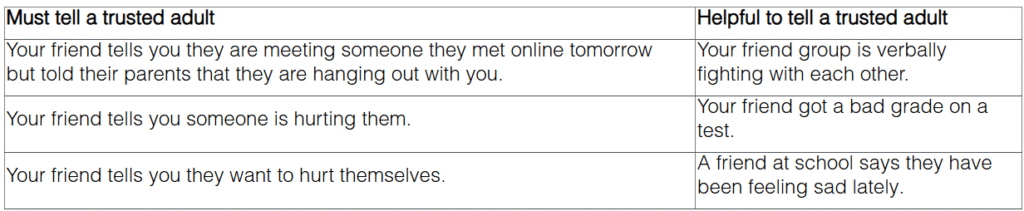
when to share a secret: a guided activity for families
To help your child understand these ideas of when to share or not to share a secret, you can try this activity as a family:
Discuss the different scenarios below with your child and help them decide which secrets should always be shared with a trusted adult and which ones can be shared if they need emotional support.
This is a great time to explain the difference between “telling on” someone—reporting when someone has done something wrong—and “telling to help” someone, which is when they need to speak up because a friend’s safety is at risk. These scenarios might not have clear or easy answers, so use them as a starting point to encourage discussions. This will help your child think through different ways to handle situations they might face.
- Your friend tells you their parents are getting a divorce.
- Your friend tells you that someone is hurting them.
- Your friend tells you they got a bad grade on a test.
- Your friend tells you that they are meeting up with someone they met on Snapchat.
- Your friend tells you they have been hurting themselves.
- Your friend shows you a dangerous item (gun, knife, weapon).
- Your friend at school is being called mean names by classmates.
- You saw your classmate cheat on their test.
- You saw a classmate crying in the bathroom.
- You broke something.
- Your friend does not eat lunch every day at school.
Teaching children the difference between surprises and secrets and when to tell a trusted adult is crucial for their safety and well-being. By discussing scenarios and practicing conversations, we empower kids to make thoughtful decisions about sharing sensitive information. Remind your child that secrets involving someone’s safety should always be told to a trusted adult, and that it’s okay to seek help when they’re unsure or need support.
more resources
Getting kids to open up can be hard.
They may turn to peers instead of us or keep their feelings to themselves. As a parent, caregiver or educator, you want to know what is going on so you can help if needed. Even when everything is going well, establishing the habit of starting conversations builds a strong foundation of communication. Take time to read our other blogs to learn more about starting the conversation with kids and supporting their mental wellness.
- how to start conversations with kids (and keep them going!)
- how asking the right questions encourages conversations
- how to recognize signs of sadness in children and show your support
join the On Our Sleeves movement
The mission of On Our Sleeves is to provide every community in America access to free, evidence-informed educational resources necessary for breaking stigmas about child mental health and educating families and advocates. For more information, visit OnOurSleeves.org.
related posts


care that goes above and beyond
Because every child deserves care that goes above and beyond, Dayton Children’s provides compassionate, expert care for kids of all ages. Find a provider, schedule an appointment, or learn more about conditions we treat today.
