As you start the school season, you may notice your child is having more trouble pooping. You’re not alone. Here are some tips to help your child feel more comfortable, whether at school or in other settings
why won’t my child poop at school?
Your child could be nervous about pooping at school for these reasons:
Bathroom anxiety – Public or shared bathrooms can feel overwhelming. Lack of privacy, noise or fear of teasing can make kids nervous to poop during school.
Not enough time – Rushed schedules, short bathroom breaks or limited teacher permission mean kids often do not have enough time to relax and go.
Lack of routine – Pooping is often tied to home routines – after breakfast, after sitting on the toilet. School disrupts that natural rhythm.
Poor bathroom conditions – Dirty stalls, lack of toilet paper or automatic flushers that startle kids are common reasons for avoiding the school bathrooms.
how are my child’s brain and body connected?
It’s important to know what can trigger the body’s stress response. We often talk about stress in terms of how we think and feel emotionally, but the body makes sense of it more broadly. Being worried about pooping at school can trigger a stress response, which can lead to physical problems. When we think about controlling the stress response in the body, we want to think about healthy habits the body needs to work well, as well as taking care of our emotional and social stress.
how can I help my child feel more comfortable pooping?
Normalize pooping – Let your child know that everyone poops, including teachers and classmates.
Problem solve – Help them determine the cleanest or least busy bathrooms.
Set up a morning poop – Give a cup of warm liquid, then 5-10 minutes of relaxed toilet time before leaving for school.
Pack fiber and hydration into lunch – Send a water bottle and remind your child to drink throughout the day. Dehydration can cause pooping to be harder. Pack things like fruits and whole grain bread to help keep poop soft.
Talk to the teacher – If your child is struggling, ask the teacher to allow flexible bathroom breaks. Many teachers understand once they know it is a medical issue not a behavioral issue.
when do I need to seek medical help for my child?
In rare cases, constipation can be caused by a larger physical problem. If your child is experiencing any of these symptoms, call your primary care provider. If they are not available, consider a visit to the urgent care or the emergency department:
Fever (constant high fever)
Blood in the stool
Vomiting blood or dark green fluid – this may need an emergency department visit
Because every child deserves care that goes above and beyond, Dayton Children’s provides compassionate, expert care for kids of all ages. Find a provider, schedule an appointment, or learn more about conditions we treat today.
starting college with a chronic condition: tips for a healthy start
Starting college is a big transition! New classes, potentially a new place to live and a lot more independence! If you’re managing a chronic condition like diabetes, epilepsy, a gastrointestinal (GI) disorder or a mental health condition, you might also be wondering how you’ll stay on top of your health while being away from home.
The good news is that a little planning can help you feel more prepared and confident before move-in day.
start planning before classes start
A few months before college starts, make a checklist of your health needs. Having a plan in place can help reduce stress once classes begin. Make a simple checklist that includes:
Medications and prescriptions
Doctor appointments
Medical supplies
Insurance coverage
Emergency contacts
School accommodations
make sure you can get your prescriptions filled
One of the most important steps is figuring out how you’ll get your medications while at school.
Before leaving for college:
Ask your doctor for enough refills to last through the semester if possible
Set reminders so you don’t run out of medication
Find a pharmacy near campus and learn how to transfer prescriptions if needed
Check if your insurance works in your college town
This is especially important for students managing conditions like:
Diabetes that requires insulin or glucose monitoring supplies
Epilepsy medications that need to be taken consistently
GI conditions that require daily medications
Mental health medications that should not be stopped suddenly
If you use specialty medications, ask your care team how deliveries will work at school.
know where to go for medical care
Before classes start, learn about the healthcare options near campus.
Find out:
Where the student health center is located
Which urgent care or emergency room is closest
Whether there are pediatric or adult specialists nearby
Some students may continue seeing their pediatric specialist during college breaks or through virtual visits. Others may need help transitioning to an adult care provider closer to campus.
Talk with your specialist before college about:
How often you need follow-up visits
What symptoms mean it’s time to schedule an appointment
What to do if you have a flare-up or emergency
take charge of your health
College is often the first time students manage healthcare on their own. Practice skills like:
Scheduling appointments
Calling in prescription refills
Tracking symptoms
Understanding your medications
Keeping important medical information in your phone can also help in an emergency. Include your diagnosis, medications, allergies and emergency contacts.
don’t ignore mental health
Changes in sleep, routines and stress can affect both physical and mental health. If you already manage anxiety, depression or another mental health condition, stick to your treatment plan and know how to access counseling services on campus.
Even students without a diagnosed mental health condition may struggle during the transition to college. Reaching out for support early can make a big difference.
build healthy habits
Healthy routines can help you manage symptoms and feel your best. Try to:
Get enough sleep
Eat regular meals
Stay hydrated
Use reminders for medications and appointments
Students with chronic conditions may also qualify for accommodations through their college’s disability services office. This could include things like flexible attendance or housing needs. Ask your doctor about any paperwork you may need before school starts.
you don’t have to figure it out alone
Starting college with a chronic condition may take extra preparation, but you don’t have to figure it out alone. Consider talking with your roommate and close friends about your health needs. Many chronic conditions are “invisible,” so others may not know when you need help unless you share it with them. Letting someone know what to watch for and how to help in an emergency can help you feel safer and more supported on campus.
Starting college can feel overwhelming, especially with a chronic condition, but support is available. Your healthcare team, family and school resources are there to support you along the way.
With preparation and the right support, you can spend less time worrying about your condition and more time enjoying your college experience.
Because every child deserves care that goes above and beyond, Dayton Children’s provides compassionate, expert care for kids of all ages. Find a provider, schedule an appointment, or learn more about conditions we treat today.
tips for transitioning from pediatric to adult care
Turning 18 comes with a lot of “firsts,” including taking more responsibility for your health. Along with more independence comes new responsibility, like managing appointments, understanding your insurance and speaking up about your care. For many teens and families, the move from pediatric to adult healthcare can feel overwhelming at first.
The good news? Preparing early can make the transition much smoother.
Whether your teen has a chronic condition or just visits the doctor once a year, learning how adult healthcare works is something they’ll use for the rest of their life. Here’s what families should know about transitioning to adult care and how to prepare now.
what changes when you turn 18?
At age 18, you become a legal adult. This means:
You make your own medical decisions
Healthcare providers will speak directly to you
Your medical records become private
Parents or caregivers can no longer access your information without permission
Medical bills will be in your name
Even if you stay on a parent’s insurance plan, these responsibilities will shift to you.
why transitioning to adult healthcare matters
Learning how to manage your health helps build confidence over time. It also prepares teens for college, work, sports and everyday adult life.
For teens with chronic conditions or ongoing medical needs, planning ahead is especially important.
tips for teens preparing for adult care
The best time to prepare for adult healthcare is before turning 18. Small steps now can help teens feel more confident later.
1. Start taking part in appointments
Practice answering questions during doctor visits instead of letting a parent answer everything. Try asking at least one question during each appointment.
2. Learn about your health history
Teens should know:
Current medications
Allergies
Past surgeries or medical conditions
Family health history
Vaccine history
Keeping this information organized can make appointments much easier.
3. Practice real-life healthcare tasks
Begin practicing skills like:
Scheduling appointments
Checking in at visits
Refilling prescriptions
Logging into MyChart
Calling the doctor’s office with questions
These are small steps that build confidence over time.
4. Understand HIPAA and medical privacy
HIPAA is a law that protects private health information. Once a teen turns 18, healthcare providers can’t share medical information with parents or caregivers without permission.
Teens can choose to share access by signing a release of information form.
tips for parents supporting the transition
For parents and caregivers, this transition can feel emotional. It may be hard stepping back after years of managing everything. The goal is to move from managing care to supporting independence.
Here are ways parents can help:
Talking about medical forms like release of information or healthcare power of attorney if needed
Encouraging teens to practice healthcare tasks
Review insurance information together
Talking about how involved they want to be after age 18
transitioning to adult care for teens with chronic conditions
Teens with chronic illnesses, complex medical needs or disabilities may need extra support during this transition.
Some conditions require ongoing care into adulthood. These conditions may include:
Diabetes
Epilepsy
Asthma
Heart conditions
Gastrointestinal disorders
Mental health conditions
Families should start talking with their healthcare team early about transition planning, adult specialists and long-term care needs.
a simple healthcare transition checklist
Before turning 18, teens should try to:
Know their medications and allergies
Carry an insurance card
Schedule an appointment on their own
Refill a prescription
Log into MyChart
Ask questions during appointments
Understand who has access to their health information
growing into independence
Transitioning to adult care does not happen overnight. It is a gradual process that takes practice, patience and support from both teens and caregivers.
With preparation and guidance, teens can feel more confident taking charge of their health and future.
If you have questions about transitioning to adult healthcare, talk with your child’s primary care provider for additional support and resources.
Because every child deserves care that goes above and beyond, Dayton Children’s provides compassionate, expert care for kids of all ages. Find a provider, schedule an appointment, or learn more about conditions we treat today.
Toddlers and pre-school aged children tend to experience the most extreme feelings of anxiety, sometimes related to separation. It is also at this age that parents tend to begin dropping their children off at day care during the work day. Naturally, the transition into a new and unfamiliar routine can prompt tantrums caused by your child’s anxiety.
No parent wants to see their child stressed. When your child is upset and begging you not to leave, the temptation to give in to their demands can be very real. Knowing whether to stay or leave during your child’s emotional outbursts is a challenging decision for parents.
five tips to smooth out the drop-off process and ease your child’s separation anxiety:
Keep goodbyes brief and consistent. Having a routine with your child that you practice at the same time every day can help make the goodbye easier for both parents and children. If you stick around longer, there is more time for anxiety to build up.
Be affectionate and attentive before you leave. This will help comfort your child and build their trust. Even if they beg you to stay longer, keep the goodbye brief but meaningful.
Have a plan your child can understand. When you are telling your child goodbye, explain to them when you will be back in a way that is easy for them to understand. You might tell them you will return after snack or nap time. Communicating a plan to your child in their own terms will make the separation less stressful, because they understand it will come to an end.
Stick to your plan. After you drop your child off, try your best not to return sooner than you promised them you would. If you are missing your child, or are feeling guilty about your child’s anxiety, that is okay! Staying consistent with your drop-off and pick-up routine will help ease the process over time. Going back sooner than planned may only feed into your child’s behaviors at drop-off in the future.
Practice separation at home. Asking grandparents, friends or other family members to watch your child for a short period of time will make separation more normal for both you and your child. If you can do this before dropping your child off at daycare for the first time, it might help reduce feelings of anxiety throughout the new transition.
Designate a transition object. This can be an item that your child carries from home to school as reminder of the process. Some kids take a picture of their family, a stuffed animal that stays in their backpack or maybe a lunch box that signifies that it’s time to go to school.
Take heart in knowing that expressions of separation anxiety in this first big transition for your child is a sign of their love and attachment to you. Day care drop-off is a great opportunity to build your child’s trust in you, along with their own sense of independence. For more information about separation anxiety in children visit the American Academy of Pediatrics.
Because every child deserves care that goes above and beyond, Dayton Children’s provides compassionate, expert care for kids of all ages. Find a provider, schedule an appointment, or learn more about conditions we treat today.
After a summer filled with family adventures and quality time spent with your child, back to school season has rolled back around already. For some children entering elementary and middle school, this may mean the start of riding the bus.
Riding the bus is an important lesson in independence for children. It can also be a source of separation anxiety for both parents and kids. This transition in your child’s educational journey requires significant trust in your child, their peers, and the bus driver to get them to school safe and sound.
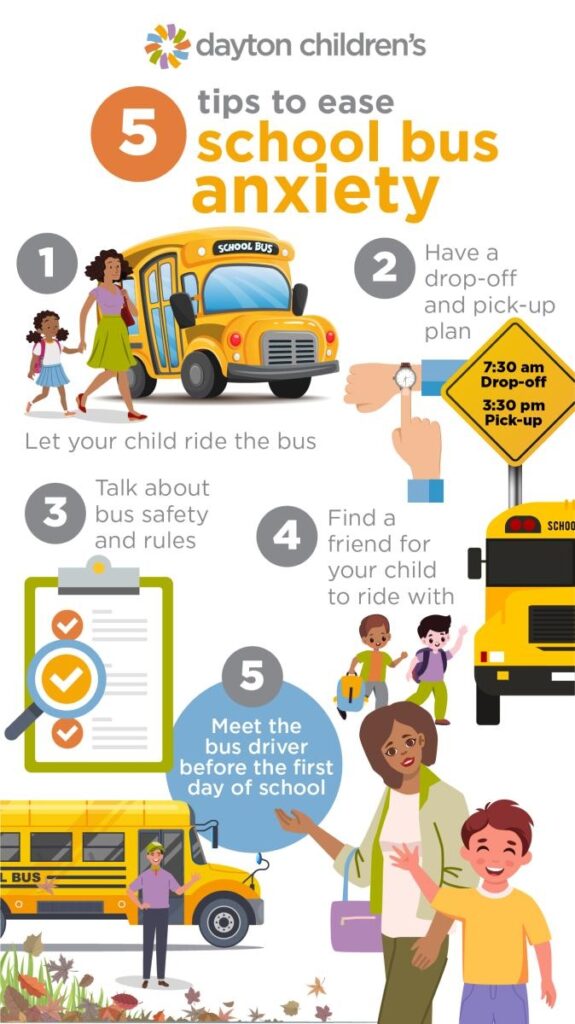
5 tips to help ease anxiety related to your child’s first bus ride
1. Let your child ride the bus. It is normal for parents to want to drive their child on the first day of school, especially if either parent or child is experiencing back-to-school related anxiety. However, having your child ready at the bus stop on the first day will help establish their routine, your routine, and even the bus driver’s routine. Be caring and understanding of your child’s fears, but encourage them to be brave in trying something new.
2. Have a pick-up and drop-off plan. Come up with a plan to take your child to the bus stop and be there when they return. If work or other obligations make this impossible, try to have another familiar adult, sibling or friend there for your child. This can help ease your anxiety and comfort your child as they get used to a new routine.
3. Talk about bus safety and rules. Make sure your child knows how to be safe around the road and other vehicles. Talking about safety rules with your child before the first day of school can help both of you feel more comfortable with bus transportation. You might talk to them about:
Waiting for the bus to stop completely before walking toward it
Always looking both ways to be sure traffic has stopped before crossing the street
Only walking in front of the bus when it is stopped and the driver says it is safe
Staying in their seat while the bus is moving
Using a quiet voice on the bus to avoid causing distractions for the bus driver
4. Find a friend for your child to ride with. Having a friend who will be riding the same bus as your child can help ease their anxiety as they leave home on the first day of school. Encourage your child to talk to the other children at the bus stop or on the bus.
If possible, find a time for your child to meet their bus driver before the first day of school. This may help them feel more comfortable with the new transition.
5. Meet the bus driver before the first day of school. If possible, arrange a time to meet your child’s bus driver prior to the first day. Most bus drivers practice their routes leading up to the start of the new year.
Get in contact with your child’s school to find out when your bus driver will be doing this and see if it’s possible for you and your child to meet the bus driver at the bus stop. This can help ease first day jitters.
If your child is experiencing extreme anxiety about riding the bus for the first time or returning to school this year, try these tips to help your child work through these feelings.
Because every child deserves care that goes above and beyond, Dayton Children’s provides compassionate, expert care for kids of all ages. Find a provider, schedule an appointment, or learn more about conditions we treat today.
10 safe food options to pack if your child attends a nut-free school
Did you know that about 1 in 50 children has an allergy to nuts? For some children, consumption of a small amount of peanut can cause a severe allergic reaction.*
A nut allergy is a serious thing and is becoming more common in children. Many schools and camps have started to implement nut-free or nut-aware environments to keep kids with allergies safe. A nut-free or nut-aware environment may prove to make lunchtime a challenge for parents whose kids are PB&J fanatics.
So, what is safe to send, and what should be avoided when packing lunch for your child or sending in snacks? We checked in with Dr. David Morris, division chief of allergy and immunology at Dayton Children’s to get answers to the questions we all want to know.
what is the difference between nut-free and nut-aware?
Environments with a nut-free policy will typically enforce a ban on peanuts and tree nuts. This means nut products are not allowed on the premises, at all. While nut-aware environments will allow nuts on the premises, but heavily discourage them.
Nut-aware environments put a lot of effort into preventing cross contamination through proper handling of food and proper hygiene. They will usually have a nut-free table for children with an allergy to eat at during mealtime. Many districts have made these tables optional for the food allergic child.
what foods should be avoided if my child is in a nut-free environment?
Every policy may differ based on the type of nut-free environment needed by those with a severe food allergy. To be on the safe side it is generally best to avoid sending any type of peanut or tree nut with your child. This includes:
Almonds
Brazil nuts
Cashews
Chestnuts
Hazelnuts
Hickory nuts
Macadamia nuts
Pecans
Pine nuts
Pistachios
Walnuts
how do I know if a food is nut-free?
The best way to be sure if a food is nut-free is to read the label and check the ingredient list. Foods sold in the Unites States are required to state on their labels if the food contains peanuts or tree nuts (per the Food Allergy Labeling and Consumer Protection Act of 2004). After checking the ingredients list, look on the label for phrases like “may contain tree nuts” or “produced on shared equipment with tree nuts or peanuts.” Foods with these warnings on the label may be consumed by children without food allergies as these are unlikely to cause reactions in food allergic children from cross contamination (when eaten by other children). Parents should check their specific school regulations.
other high-risk foods
When thinking about classroom treats or field trips, parents should read labels carefully. According to KidsHealth there are other high-risk foods for people with peanut or tree nut allergies because of potential cross-contamination that may not be mentioned on the food label.
Cookies and baked goods. Even if baked goods don’t contain nut ingredients, it is possible that they came into contact with peanut or tree nuts through cross-contamination. Unless you know exactly what went into a food and where it was made, it’s safest to avoid store-brought or bakery cookies and other baked goods.
Candy. Candies made by small bakeries or manufacturers (or homemade candies) may contain nuts as a hidden ingredient. The safest plan is to eat only candies made by major manufacturers whose labels show they are safe.
Ice cream. Unfortunately, cross-contamination is common in ice cream parlors because of shared scoops. It’s also a possibility in soft-serve ice cream, custard, water ice, and yogurt shops because the same dispensing machine and utensils are often used for lots of different flavors. Instead, do as you would for candy, buy tubs of ice cream at the grocery and be sure they’re made by a large manufacturer and the labels indicate they’re safe.
Asian, African and other cuisine. African and Asian (especially Thai, Chinese and Indian) foods often contain peanuts or tree nuts. Mexican and Mediterranean foods may also use nuts, so the risk of cross-contamination is high with these foods.
Sauces. Many cooks use peanuts or peanut butter to thicken chili and other sauces.
what can my child pack for a nut-free lunch?
For starters, you don’t have to veer too far from your child’s love of PB&J. Try using a sunflower seed butter instead of peanut butter, almond butter or hazelnut spread. Your child probably won’t even notice a difference. Lunch meat is also a safe option if your child likes a little variety.
If sandwiches aren’t your child’s “jam,” below is a list of other healthy and safe food options your child could enjoy in a nut-free environment.
String cheese
Fruit: fresh, dried, freeze-dried, fruit leathers, dried fruit bars, fruit cups
Vegetables
Individual guacamole and hummus cups
Hard-boiled eggs
Yogurt cups/tubes
Cottage cheese
Meat sticks/jerky
Pretzels
Animal crackers
As a best practice we still recommend you always check a food’s ingredient label. One brand of a certain type of snack may be safe, while another may contain nut ingredients.
what is the future of nut-free schools?
In May 2021, new guidelines recommended against bans of specific foods including nuts. There is not enough evidence for or against site wide (nut free schools) bans. Concerns surround the impact of site wide food bans on the psycho-social well being of not only the children with food allergies but also children without these allergies. These impacts were measured against the mitigation of risks provided by site wide food bans. Unfortunately, there is not enough evidence that these bans prevent reactions. These concerns are what prompted the recommendation against the ban.
so what can parents do to help, now?
As stated, evidence for site wide food bans is low. Dr. Morris encourages parents to “stay tuned” as more evidence will be forthcoming. Until that time, he recommends the five tenets set out by the CDC in their voluntary guidelines for schools regarding food allergy:
Ensure the daily management of food allergies in individual children.
Prepare for food allergy emergencies.
Provide professional development on food allergies for staff members.
Educate children and family members about food allergies.
Create and maintain a healthy and safe educational environment.
Education about food allergy is important to help all our children (allergic and non-allergic) to thrive.
*Note: severe allergic reactions do not occur with only contact exposure.
Because every child deserves care that goes above and beyond, Dayton Children’s provides compassionate, expert care for kids of all ages. Find a provider, schedule an appointment, or learn more about conditions we treat today.
5 tips to help student athletes adapt to the college environment
By: Dr. Tiffany Ofili Porter
Regardless of what stage you are in life, having to deal with transitions is inevitable. As intimidating as it may seem, looking at change as an opportunity instead of something to be feared will make life’s transitions that much easier.
As someone who has been through every transition along my athletic journey, I have first hand experience with the difficulty of walking into the unknown. I know what it feels like to go from a preschooler racing in the streets all the way to a world championship medaling hurdler competing at three consecutive Olympic Games.
There are several lessons I learned along the way, and I have tips on how to help student-athletes cope with the transition to college.
1) Understand that you will become a “small fish in a big pond”
If you’re an athlete preparing to compete at the college level, chances are you’re one of the best, if not the best athlete in your high school. Maybe even in your state. And that’s incredible, congratulations.
But be prepared to be surrounded by other amazing athletes who are also standouts just like you. Some of your fellow incoming freshman teammates may be better than you, and it’s likely that many of the upperclassmen probably will be. And that’s ok. It should even be welcomed and embraced.
If you come into collegiate sports with the understanding that you’re going to be up against much stiffer competition both on your team and rival teams, it will make the transition smoother and less of a shock. I encourage you to approach this shift as an opportunity to learn new techniques from your college coach(es) on how to improve and step up your game. Ask lots of questions, and remember that everyone has to start somewhere; even the best athletes were rookies at one time.
2) Establish your tribe
Have you ever heard the saying “you’re the sum total of the 5 people you spend the most time with”? Well it is very true and we must be intentional with who we surround ourselves with because they can have a profound impact on your success as a student-athlete.
The college experience comes with a lot of freedom to make your own decisions, and that can be good, or bad, depending on how you use it. Will you choose friends who will encourage you to kill it at practice everyday, or friends who will pressure you to party every day and neglect your sport? Life is about balance, and with good time management, you can have a fulfilling college social life while still striving for greatness in your sport. With the right people in your corner, finding this balance will be so much easier.
I found while I was in college the majority of my friends were also athletes because they understood my lifestyle, and we were able encourage each other in ways that non athletes may not fully understand.
3) Utilize the available resources
Many colleges and universities recognize how difficult it can be to successfully juggle work in the classroom, and in your sport simultaneously. As a result, they will have resources available to help lessen the burden. These include special tutoring sessions, designated study times or study venues and trained counselors/advisors, just to name a few. When these resources become available to you, use them! You will learn very quickly that it’s easy to become overwhelmed with the demands from coaches and professors so when there’s an opportunity to get help do not be afraid to take it. In fact, it’s a very useful skill to know how and when to ask for help.
This is not unique to athletes because many professors offer office hours to help students master the material, and they often complain that students never come. Don’t be that person. If you have questions, ask. If you need guidance, seek it out. You’ll be a better student and a better athlete for it.
4) Remember that you’re a STUDENT-athlete for a reason
A big part of college is finding your identity and it’s easy for student-athletes to fall into the trap of being so wrapped up in sport that they forget they’re also there to get an education. If you’ve made it to the college sports level, it means you’re very committed to excellence in athletics, but it’s imperative to keep that same energy in the classroom. As someone who was able to successfully achieve a very high level of success in the classroom and on the track, use my experience as proof that it can be done.
Were there times I felt discouraged about a bad race or bad exam grade? Sure. Were there days I doubted if I would actually be able to pull off becoming a pharmacist and professional athlete simultaneously? Yes. Were there moments I felt inadequate and incapable of achieving the insanely large goals I set? Absolutely.
But I surrounded myself with people who encouraged me and uplifted me when I needed it the most. This goes back to the importance of having a good support system.
5) Keep an open mind
The quicker you realize that things will look different than they did in high school, the quicker you will be able to adjust to college life as a student-athlete. Your teammates will be different. Your coach(es) will have different styles. Your professors will instruct in a different way. Your classes will be structured differently. The pressures will be different. The expectations will be different. And these differences should be embraced.
The good news is, you already have what it takes to be successful, otherwise you wouldn’t be where you are right now. Take that confidence with you, but also keep in mind that you will have to adjust and you will be taken out of your comfort zone regularly. Keeping an open mind when learning your new coach’s methods, or your professors’ quirks will help ease the transition.
Congratulations on all of your accomplishments thus far, and I hope that the next chapter in your story is even better than the previous one. Change can be a little frightening, but with the right mindset and perspective, it doesn’t have to be. I hope you find these tips useful as you prepare for the next stage in your sports career. Here’s to smashing goals, fostering life long friendships, embracing change and making great memories. You’ve got this!
meet the author
Dr. Tiffany Ofili Porter is a Michigan native and currently works as a pharmacist, digital content creator and sports broadcaster. She is a former world class Olympic hurdler and ran track professionally for 12 years. During that time, Tiffany competed in the 2012, 2016, and 2020 Olympic Games, earned four world championship medals and currently holds the British National records in the 60 and 100 meter hurdles. She was also European Champion, Commonwealth Games silver medalist, Continental Cup silver medalist, World Junior Championship silver medalist and earned several European medals during her tenure.
Tiffany graduated from the University of Michigan in 2012 where she earned her Doctorate of Pharmacy. During her time at U of M she was a five-time NCAA champion, team captain, school record holder, Big Ten Medal of Honor recipient, Academic All-American, Vice President of SNPhA and a member of the pharmacy school Leadership Scholars Program. In 2014 Tiffany was inducted into the University of Michigan Track and Field Hall of Fame.
To learn more about Tiffany & follow her journey, please visit: www.tiffofili.com
Because every child deserves care that goes above and beyond, Dayton Children’s provides compassionate, expert care for kids of all ages. Find a provider, schedule an appointment, or learn more about conditions we treat today.
To provide the best experiences, we use technologies like cookies to store and/or access device information. Consenting to these technologies will allow us to process data such as browsing behavior or unique IDs on this site. Not consenting or withdrawing consent, may adversely affect certain features and functions.
Functional
Always active
The technical storage or access is strictly necessary for the legitimate purpose of enabling the use of a specific service explicitly requested by the subscriber or user, or for the sole purpose of carrying out the transmission of a communication over an electronic communications network.
Preferences
The technical storage or access is necessary for the legitimate purpose of storing preferences that are not requested by the subscriber or user.
Statistics
The technical storage or access that is used exclusively for statistical purposes.The technical storage or access that is used exclusively for anonymous statistical purposes. Without a subpoena, voluntary compliance on the part of your Internet Service Provider, or additional records from a third party, information stored or retrieved for this purpose alone cannot usually be used to identify you.
Marketing
The technical storage or access is required to create user profiles to send advertising, or to track the user on a website or across several websites for similar marketing purposes.