Worried about your new teen driver facing an emergency on the road? You’re not alone. While we can’t predict every situation, you can help them feel prepared. Prepare your teen to handle these five common driving emergencies safely and with confidence:
- Car crashes
- Car emergencies on the highway
- Problems with passengers or other drivers
- Pulling over for emergency vehicles
- Dealing with emergencies and no cell service
car crashes
Car crashes are a leading cause of death and injury for teens and range from minor fender benders to fatal crashes. If you are in a crash, remember:
- Stay calm: Counting to 10 and taking a few breaths can help you think clearly. Then check to make sure that no one in the car or involved in the accident is hurt.
- Call 911: If anyone is hurt, if the airbags deployed, or your car isn’t drivable, call 911 immediately. The dispatcher will ask for details and keep you on the line until help arrives. If you’re on the highway look for mile markers and highway signs to help them find you more easily!
- Move to safety: If it’s a small accident and you can safely move your car, move it out of traffic, onto a sh
- It is leaking fluids
- There is major damage
- You’re near a busy highway or intersection
- There is bad weather or it’s hard to see where you’re going
- Set up warning signals: Turn on your hazard lights and, if possible, set up warning triangles or flares. Stay away from traffic or stay inside your car with your seatbelt on if you’re near a busy road or highway.
- Document the incident: Write down details about the crash like the date, time, weather, and accident specifics. Take pictures of the scene and any damage. exchange information with the other driver and file a police report. Get the other driver’s name, contact info, driver’s license number, insurance details, and license plate number.
- Follow up: If you feel sore or dizzy in the days after the accident, make sure to see your doctor.
problems with passengers or other drivers
If someone you’re driving with starts acting erratically or has a medical emergency, your first priority is safety. Here’s what to do in this situation:
- Pull over safely: As soon as you notice the person’s behavior or medical issue, safely pull over to the side of the road or find a safe spot to park. Turn on your hazard lights to alert other drivers.
- Stay calm and assess the situation: If the person is conscious and able to communicate, ask them what’s happening. If they’re not responsive, you may need to take immediate action. If the person is acting strangely, angrily or dangerously, leave the situation if you can and go somewhere safe. Leave your car, you will be able to get it back eventually, but your safety is a priority.
- Call 911: If there’s any medical emergency, immediately call 911. Describe the situation, including the person’s symptoms or condition, and follow any instructions the dispatcher gives you.
- Road rage moments: If you’re dealing with another driver or passenger’s road rage, stay calm and avoid escalating the situation. Keep your eyes on the road and if you can do it safely, pull over to a safe, busy area like a shopping complex. Lock your doors and call 911.
safely making space for emergency vehicles
When you see flashing lights and hear the sounds of sirens, that means you need to pull over for an ambulance or other emergency vehicle! In Ohio, it is required by law to pull over, so here’s how you can do that safely:
- Stay calm and assess: As soon as you hear sirens or see flashing lights, check your mirrors to see where the vehicle is, where it’s coming from and where it’s going.
- Move to the right: If you’re on a multi-lane road, move to the rightmost lane and slow down. If you’re already in the right lane, safely pull over to the shoulder. On a two-lane road, stop and remain where you are.
- Yield and stop: Always move over and make space for emergency vehicles, even if they’re approaching from behind. Stop and wait until the emergency vehicle passes.
- Don’t block intersections: If you can avoid it, don’t stop in an intersection. If you’re in one then make sure to get out of it as soon as you can.
- Stay put: Once you’ve stopped, stay in your car until the emergency vehicle has passed. Then, carefully merge back into traffic when it’s safe to do so.
Bonus: if you see emergency vehicles while driving on the highway, it is courtesy and law to safely switch to the lane farthest from the accident to make sure everyone stays safe!
dealing with emergencies with no cell service
If your car breaks down and there’s no service, move the car off the road if possible. If you can’t, turn on your hazard lights to alert other drivers. Even without service, all phones should still be able to dial 911 for emergencies. Use street signs or landmarks to help give your location when reporting to authorities. If you’re stuck in the car, keep your seatbelt on for safety and stay put until help arrives.
Stay safe & stay prepared with Navigating Teen Driving Together
Our Navigating Teen Driving Together program is here to provide expert tips and additional free tools to help you and your teen build safe driving habits with confidence.
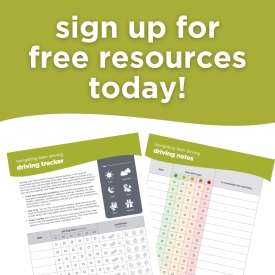
Sign up for our teen driving newsletter today and get your first free resource: a brand-new driving hours tracker! This tool helps you log the required 50 hours of practice in the most intentional way. It covers all the essentials, from nighttime driving to city streets and rural roads.
Together you and your teen can make sure they’re prepared to be safe in any circumstance as they drive on the road!